Modern manufacturing is under pressure. Factories are expected to produce more, adapt faster and operate with greater precision — all while managing increasingly complex systems, tighter margins and growing demands for flexibility. This is the challenge we set out to address.
We are bringingnext-generation 6G technologiesinto manufacturing environments
Our approach combines AI-driven network and compute optimisation, dependable deterministic connectivity, real-time sensing and virtualised cobotic control into a unified platform designed for the demands of advanced manufacturing.
PRIME-6G in a nutshell


6G Connectivity

Artificial
Intelligence

Cloud-Edge
Computing

Robotics

Real-Time
Sensing

Smarter
More Flexible

More Resilient
Factories
Our work is grounded in a clear premise: smart, autonomous factories can only reach their full potential when technology works together seamlessly, reliably and in real time. 6G is the foundation that makes this possible.
By bridging telecommunications, industrial automation, and intelligent computing, we are paving the way for flexible, sustainable, and human-centric factories that can respond in real time to operational challenges, production variability, and emerging market needs.
This innovative work will impact a diverse array of stakeholders involved in shaping the future of manufacturing.



Our work is structured around two complementary industrial use cases — AURORA and SENTINEL — each addressing critical challenges in next-generation manufacturing. Selected key components will be integrated into a unified platform and tested in a real industrial environment that will demonstrate how 6G-enabled smart manufacturing can become more adaptive, connected, efficient and resilient in practice.
Six Objectives. One Integrated Platform.
Objective 1Designing the PRIME-6G Platform Blueprint
We define the architecture of our platform, identifying the key components needed to meet the functional and performance requirements of our use cases. This includes integrating critical 6G capabilities such as ultra-reliable, real-time communication and high-accuracy positioning. We also assess commercial and open-source building blocks, benchmark them against our requirements, and develop a techno-economic evaluation to support a clear commercialisation plan.
Objective 2Validating the AURORA Use Case
Through AURORA, we tackle one of the most pressing challenges in modern manufacturing: the shift towards batch size one production. This demands high flexibility, not just in minimising setup times, but in intralogistics and autonomous vehicle deployment. We validate how 6G-enabled, agent-based coordination can allow vehicle fleets to scale dynamically, execute collaborative transport tasks, and interact autonomously with infrastructure elements such as doors and ramps, achieving full end-to-end automation.
Objective 3Validating the SENTINEL Use Case
Through SENTINEL, we demonstrate how Integrated Sensing and Communication (ISAC) with 5G/6G and Wi-Fi infrastructure can construct comprehensive, real-time digital twins (DTs) of dynamic industrial environments, including moving robots, static obstacles, and human presence. Validation takes place in a representative industrial setting, with performance assessed against stringent key performance indicators (KPIs) and key value indicators (KVIs) in areas including sensing accuracy, human-robot cohabitation safety, visionless operation, and sensing latency.
Objective 4Integrating Both Use Cases into a Unified Trial and Pilot (T&P)
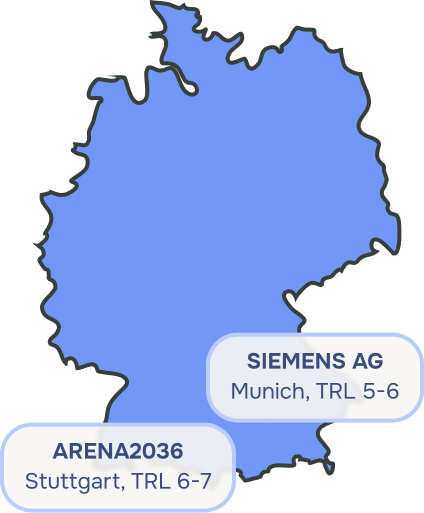
We bring together the validated technologies from AURORA and SENTINEL into a single, integrated TRL 6–7 environment at ARENA2036. Here, deterministic networking and real-time sensing operate complementarily, enabling collaborative robots through enhanced environmental awareness. The integrated platform is designed for replication across other industrial sites and demonstrated to stakeholders from multiple verticals to assess impact and promote cross-sector adoption.
Objective 5Building a 6G Industrial Business Ecosystem
Beyond the technology, we are committed to building the ecosystem around it. Our Consortium brings together industrial enterprises, SMEs, and academic institutions, creating the conditions for partnerships, knowledge transfer, and commercial uptake. We also run the PRIME-6G Innovation Challenge, designed to identify real-world business pain points, showcase our innovations, and highlight the scientific and commercial value of our work.
Objective 6Disseminating and Exploiting Our Results
We are committed to ensuring our results reach the broadest possible audience through Open Science (OS) practices, strategic communication across EU digital and policy bodies, and active engagement with industrial players, research communities, and standardisation bodies. Our goal is not just to generate results, but to ensure they are transferred, replicated, and built upon across the European ecosystem.
Where We Push the Boundaries
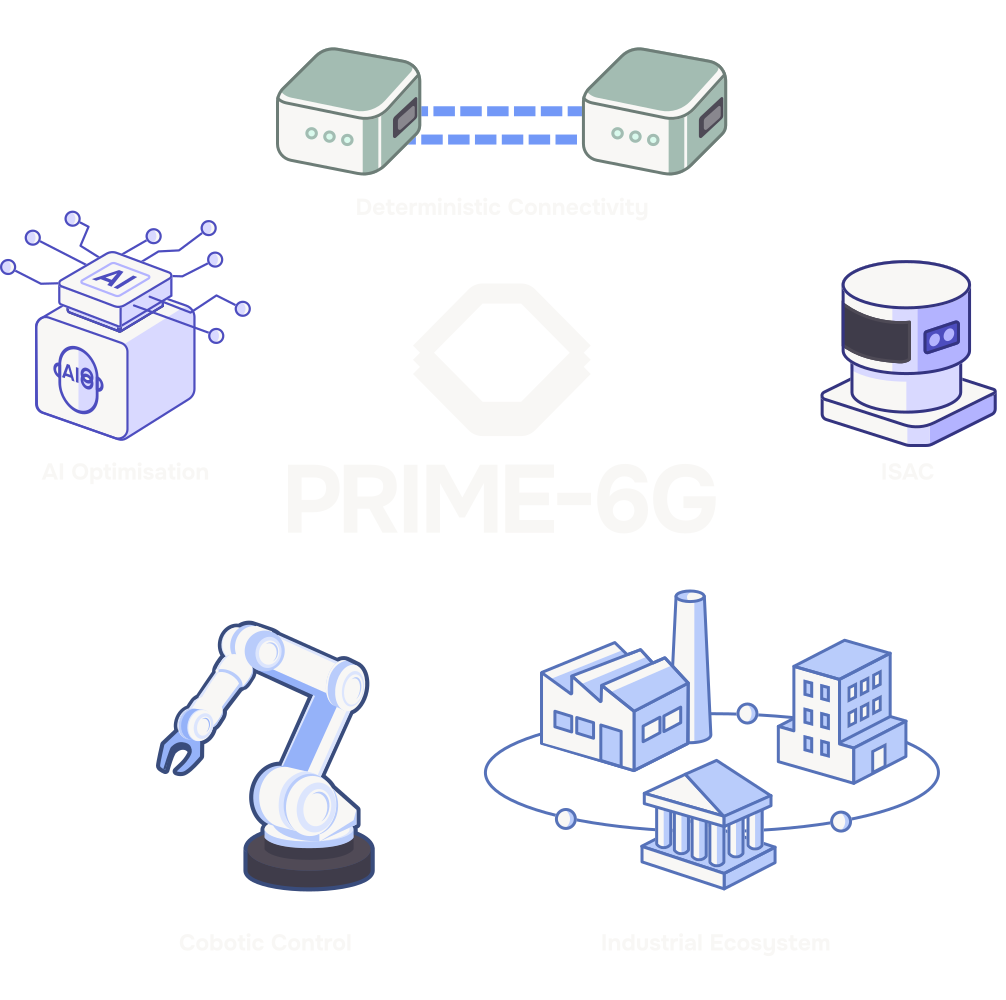
- AI-driven Network and Compute Optimisation for Collaborative Industrial Agents
- End-to-End Deterministic Connectivity over Hybrid Domains
- Real-time Multi-modal Sensor Fusion with ISAC for Robot Control and Environment Mapping
- Cobotic Control Placement across the Telco Edge Cloud
- 6G-enabled Industrial Ecosystem and Standardisation
Expected results and impact
- Setting the foundation for perceptive, adaptive, and resilient 6G-enabled industrial environments.
- Enabling safer cobotic collaboration in challenging industrial environments with dust, poor lighting, or occlusions thanks to the integration of ISAC with real-time sensor fusion and to deterministic wireless networking for cobotics over hybrid domains.
- Addressing current challenges that affect the industry, from technical constraints (i.e., latency uncertainty and poor synchronisation across diverse technologies) to deployment costs (i.e., costly vision systems) and migration and adoption hurdles.
- Increasing operational safety, resilience, and adaptability, directly improving efficiency in advanced manufacturing through enhanced robotic performance.
- Improved productivity and flexibility in smart manufacturing.
- Conducting demonstrations that offer scalable models for the industry.
- Contributing to AI-driven management, optimisation, and ISAC interoperable frameworks and alignment with IMT-2030 vision framework [IT23], that highlights ISAC and AI as central pillars of 6G, alongside overarching design principles such as sustainability, ubiquitous intelligence, and security.
- Translating scientific results and innovations into standards through our work with 3GPP, IEEE, ITU, IETF, O-RAN, and ETSI.
- Improving trust, confidentiality, security, privacy and safety.
- Lowering energy consumption, reducing dependence on costly vision systems and exploiting existing infrastructure.
- Promoting digital inclusion.
PRIME-6G: From Lab to Factory Floor
Our platform is designed around a concrete industrial scenario: a factory complex where fixed and mobile robots execute manufacturing tasks across a heterogeneous connectivity environment.
The factory floor hosts extreme-edge computing resources, linked to a hierarchy of edge and cloud platforms forming the Cloud-Edge Continuum. Virtualised robotic control can migrate dynamically across this continuum to meet changing service requirements, with centralised control coordinating swarms of collaborative robots when needed.
This is the environment in which AURORA and SENTINEL operate, and in which our integrated demonstrator brings them together into a single, coherent platform.
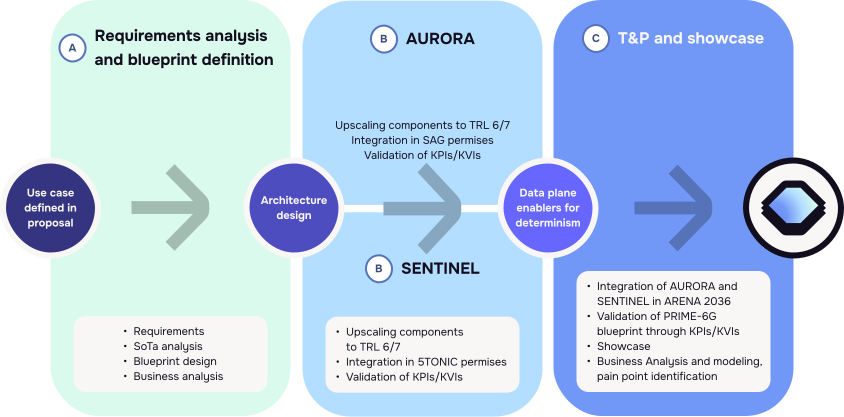
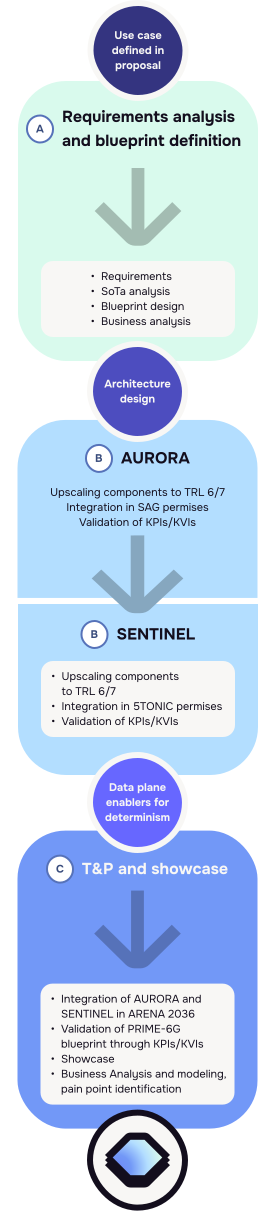
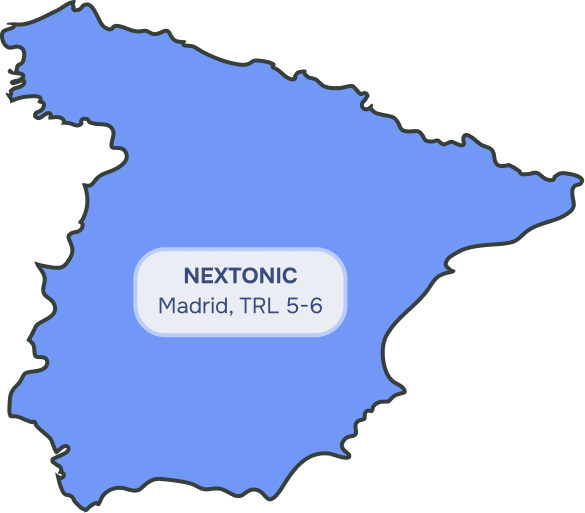
We believe that meaningful innovation must be validated under real-world conditions. That is why our development pathway is structured as a progression: from controlled laboratory environments at TRL 5–6, to a fully integrated industrial demonstrator at TRL 6–7.
This progression ensures that what we build is not just technically validated but ready for deployment in real industrial environments, and designed to be replicated across the broader European manufacturing sector.