
Our work is built around a clear ambition: to show what becomes possible in real industrial manufacturing environments when 6G connectivity, AI-driven automation, and real-time sensing work together as a coherent system.
To achieve this, we have designed two complementary industrial use cases: AURORA and SENTINEL. Together, they address the full picture of what smart, connected, and autonomous factory operations can look like in practice.
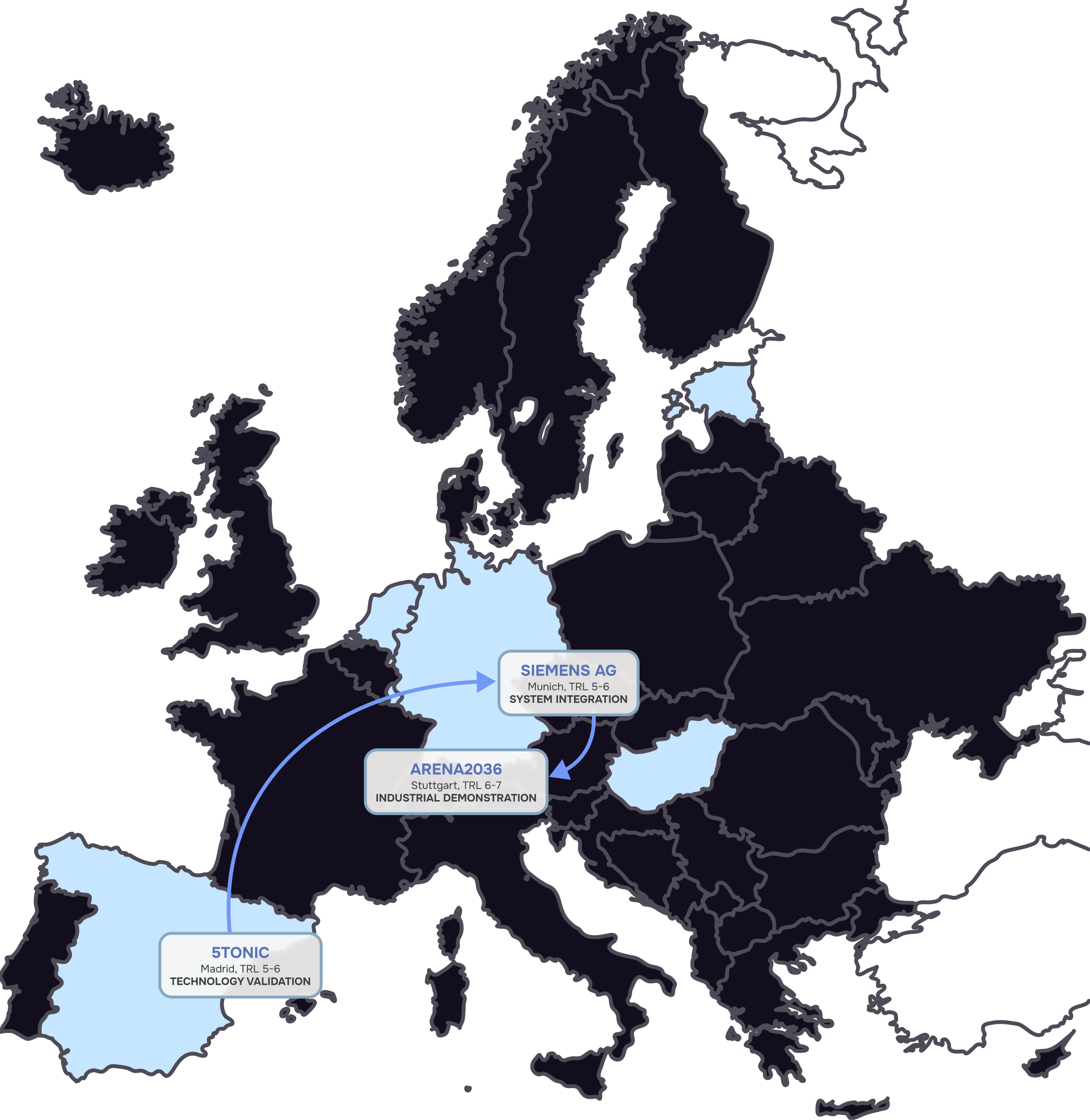
Both are developed and validated in a structured progression. Key technologies are first validated at Technology Readiness Levels (TRLs) 5 and 6 in our partner laboratories — NEXTONIC in Madrid and the Siemens AG facility in Munich. Selected components are then brought together into a unified TRL 6–7 demonstrator focused on “Real-time Contextual Awareness for Self-Organising Logistics” at ARENA2036 in Stuttgart, where AURORA and SENTINEL operate as an integrated platform in a real-world industrial environment.
AURORAAdvanced Unified Robotics Operations via Resilient Automation
The Challenge
Manufacturing facilities are under growing pressure to become more flexible. As production shifts towards smaller batch sizes and more varied product lines, the systems managing intralogistics — the movement of materials and components within a factory — must adapt rapidly and reliably.
Today, this adaptation requires considerable manual effort. Fleet management systems are largely centralised, making them vulnerable to single points of failure and slow to respond to changing conditions. Reconfiguring a production facility, scaling a vehicle fleet up or down, or handling a system malfunction all demand significant human intervention.
Our Solution
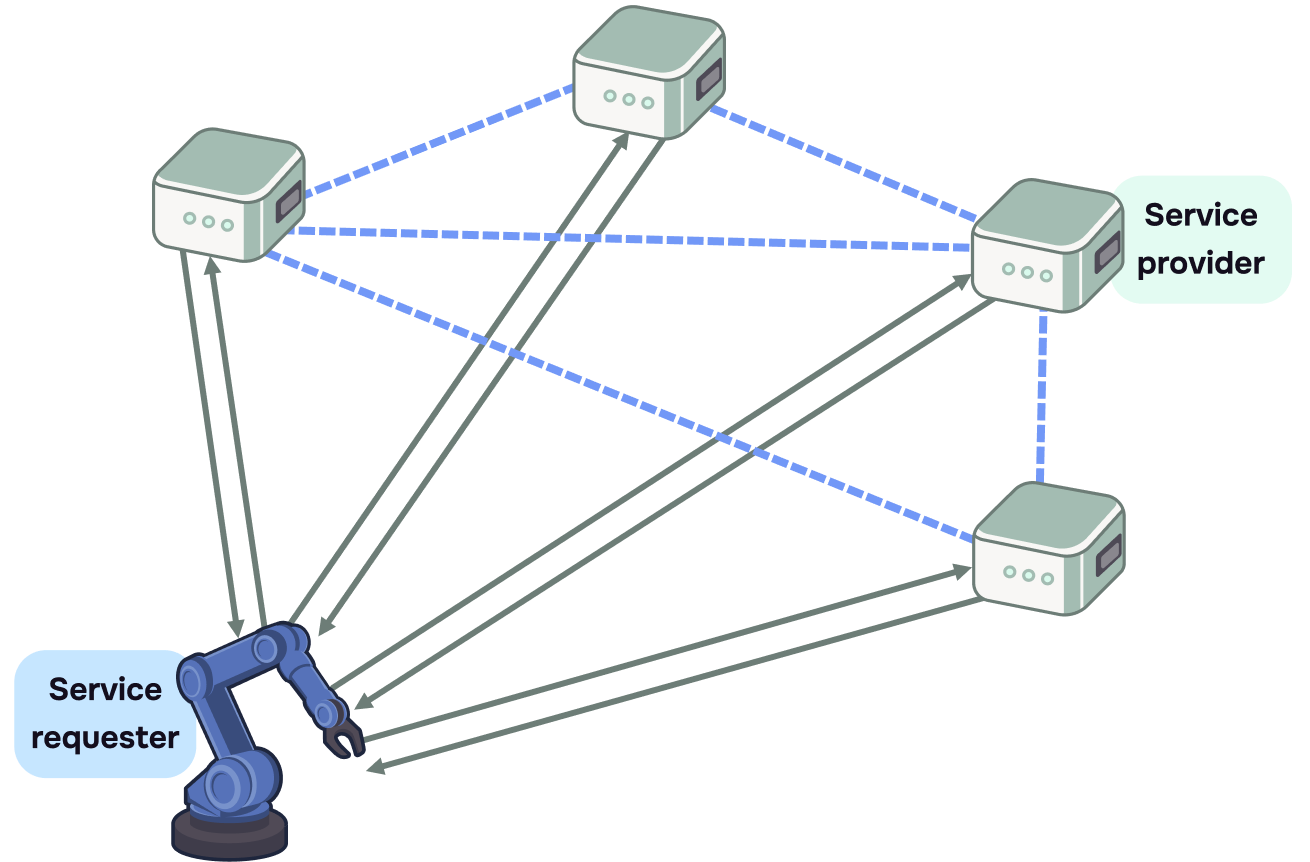
AURORA investigates how deterministic 6G connectivity can enable a new generation of distributed, self-organising logistics systems — where autonomous vehicles coordinate themselves, adapt to changing conditions, and execute collaborative tasks without relying on a central controller.
At the heart of AURORA is a distributed fleet management system in which Autonomous Guided Vehicles (AGVs) and Autonomous Mobile Robots (AMRs) operate as intelligent, independent agents.
Rather than waiting for instructions from a central system, each vehicle assesses available tasks, evaluates its own capabilities and availability, and participates in a decentralised bidding process to determine the most suitable assignment.
What AURORA Delivers
AURORA demonstrates that a self-organising, distributed fleet management system enabled by 6G connectivity and intelligent edge computing can:
- Increase productivity and flexibility in industrial intralogistics
- Eliminate single points of failure in fleet coordination
- Enable cooperative task execution between heterogeneous and universal vehicles
- Reduce the complexity and cost of AGV production by enabling unified, identically capable vehicles
- Support new, result-oriented business models in manufacturing logistics
SENTINELSensing-Enhanced Network Twin for Intelligent Environments in Manufacturing
The Challenge
Digital twins are already widely used in manufacturing, but most focus on functional emulation: modelling robot movement patterns within static factory representations. In mixed human-robot environments, this is not enough.
Safe and efficient operation in dynamic industrial settings requires continuous, real-time awareness of what is actually happening on the factory floor, including areas that cameras cannot see, and situations that change from one moment to the next. Current approaches leave significant gaps.
Our Solution
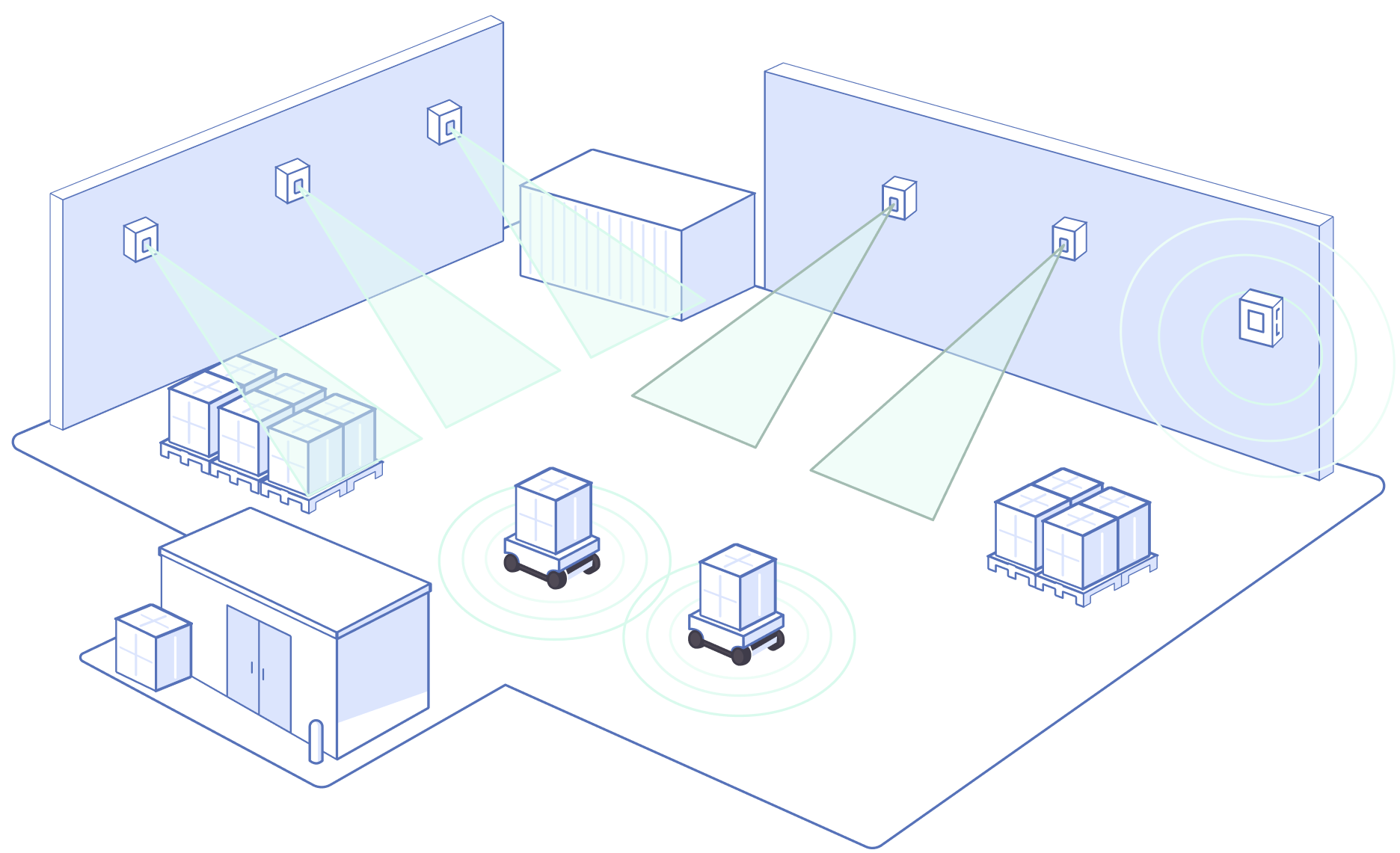
SENTINEL demonstrates how Integrated Sensing and Communications (ISAC), combined with multi-modal sensor fusion, can build real-time digital twins of dynamic industrial environments, providing a continuous, comprehensive picture of the factory floor that goes far beyond what conventional sensing approaches can achieve.
By reusing existing 5G/6G communication infrastructure for sensing purposes, alongside conventional factory sensors such as cameras, radar, and LiDAR, SENTINEL delivers a continuous 3D view of the environment, including blind spots and occluded areas that robot-mounted sensors cannot reach. This reduces the need for costly dedicated sensor hardware while improving the safety and coordination of AGVs and other mobile robots.
What SENTINEL Delivers
SENTINEL demonstrates that ISAC-enabled, multi-modal sensing, integrated with existing 6G infrastructure, can:
- Build real-time, comprehensive digital twins of dynamic industrial environments
- Provide continuous monitoring of areas beyond the reach of robot-mounted or fixed cameras
- Enhance AGV guidance, coordination, and operational safety
- Reduce dependence on costly dedicated sensing hardware
- Enable active, real-time interaction between digital twins and cyber-physical systems
When AURORA Meets SENTINELReal-Time Contextual Awareness for Self-Organising Logistics
Our final Trial and Pilot brings AURORA and SENTINEL together into a single, unified TRL 6–7 platform at ARENA2036 in Stuttgart. The integrated use case represents the culmination of our work and the fullest expression of what 6G-enabled smart manufacturing can achieve.
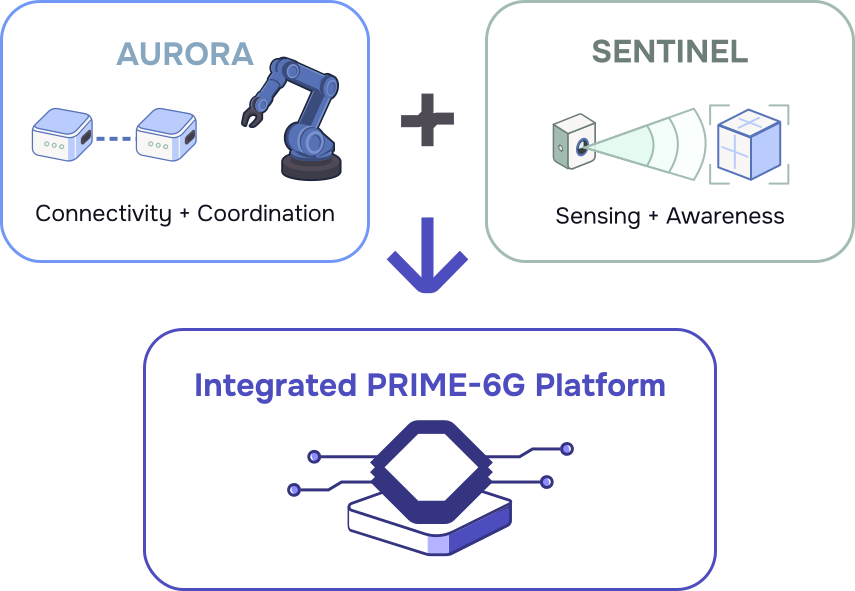
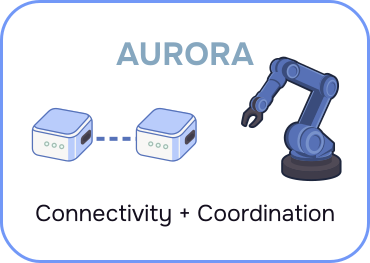

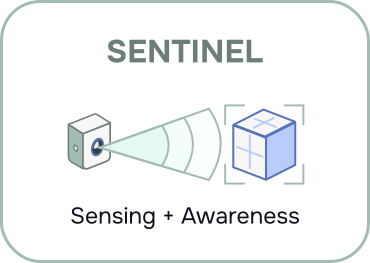

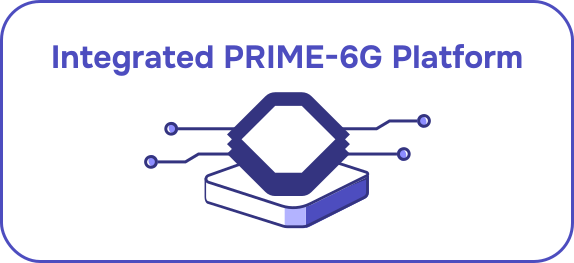
AURORA provides the intelligence and decentralised coordination for autonomous vehicle fleets, but to operate safely in complex, dynamic environments, it needs continuous awareness of what is happening around it. SENTINEL fills that gap: its real-time environmental mapping and ISAC-enabled sensing give AURORA’s autonomous agents the situational awareness they need to make safe, informed decisions.
This demonstrator advances smart manufacturing by combining five key enablers:
- AI-driven optimisation
- Deterministic connectivity
- Cobotic subnetworks
- Real-time ISAC-based sensing
- Distributed cobotic control across the Edge Cloud.
Validated at TRL 6–7 in a real-world industrial environment, the demonstrator is designed to generate industrial feedback and accelerate commercialisation potential.